Search This Blog

Saturday, 12 November 2011

Letter from London


Hackney’s heart

In the wake of this summer’s riots, the centre of Hackney may not seem an obvious choice for a day trip; and if you read Wikitravel’s hackneyed entry on the borough you certainly wouldn’t go there after dark. Yet most locals are adamant they wouldn’t want to live anywhere else and Hackney is at the heart of the 2012 Olympics, when millions of visitors from around the world will pass through Hackney Central to get to the Olympic park.

The London Borough of Hackney has long been recognised as London’s creative quarter. Shoreditch, Hoxton and Dalston are home to all sorts of cutting-edge media types and a good proportion of the capital’s coolest nightlife venues. Even lowly Hackney Wick, once an industrial wasteland, is now home to more artists (one in seven people apparently) than anywhere else in the world. But poor old Hackney Central has been rather left off the tour guide’s map of London – until now, that is.

Travel writer Jane Egginton has long counted Hackney as her favourite place in the world. Jane’s tailor-made Saturday walking tour takes in green spaces, fine foods and centres of history right in the heart of Hackney, visiting ancient and modern markets, a brand new brewery and the oldest house in East London.

Begin your Saturday with a cappuccino at Broadway Market (www.broadwaymarket.co.uk), perhaps the most obvious example of the Hackney’s gentrification. One of London’s finest food markets, barrow boys have been trading here since the 1890s. This market gets really crowded around lunch-time, when the fashionistas rouse themselves from their Friday night excesses and parade along what is known as ‘the catwalk’. No-one really comes here for their weekly shop; meat, bread, fruit and vegetables are all overpriced. Instead people come to graze on street food, strut their stuff and sup a pint at the achingly cool Cat & Mutton pub.

Originally called The Cattle & Shoulder, across the road is a clue to the pub’s name; London Fields was used by drovers to pasture their livestock on the way to market. Today this hemmed-in triangle of grass is still well-used. On hot weekends, it fills up with groups of sun-seeking trendy young things and families with picnics. There are playgrounds, a cricket pitch, tennis courts, football games and even an outdoor ping pong table to amuse the crowds.

Skirt the western edge of London Fields, perhaps taking a dip in the lovely 1930s lido with its Olympic sized pool then cross to the eastern side. Tucked away beneath the railway arches is the newly-opened London Brewery at 374 Helmsley Place (www.londonfieldsbrewery.co.uk), open by appointment only for tastings and purchases of their tasty hand-crafted beers.

This exciting enterprise is the perfect example of new Hackney and part of an increasingly powerful movement of local producers. On offer from the first commercial brewery to open in central Hackney since the 19th century are five ales whose names ring out with love for the vicinity: Hackney Hopstar, London Fields Bitter, London Fields Session Ale, London Fields Gold and Love Not War (the last apparently named during the recent disturbances).

Continue your Hackney pilgrimage to another newbie on the scene. Walk north up Mare Street (the area’s main artery, known for its Vietnamese and Turkish restaurants) and you’ll soon reach the grand old Hackney Empire (www.hackneyempire.co.uk). This Georgian jewel opened in 1901 and was one of the world’s greatest music halls, playing host to the likes of Charlie Chaplin and WC Fields perform. Recently refurbished, the highlight of its calendar is without doubt the pantomime – generally agreed to be London’s best.

Continue north towards Hackney Overground station, where you’ll find the always-busy ‘narrow way’, the centre of Mare Street shopping. Turn right, passing the 13th-century St Augustine’s Tower (Hackney’s oldest building) and into the churchyard of St John at Hackney. Right in the heart of Hackney, these bucolic church gardens are visited by three quarters of a million people every year. In the north gardens of this impressive Grade II listed church, you’ll find the Hackney Homemade market (www.hackneyhomemade.com).

A newcomer on the market scene, this is a good example of Hackney’s gentrification sitting side by side with real community effort. Each week fledgling traders offering vintage clothes, bric-a-brac and world food, side by side with charity awareness stalls and the likes of shiatsu, aromatherapy and foot massage. Hackney Homemade hosts an exciting calendar of events, including a popular summer fete, a lively food festival and a spectacular Christmas market during the first three weekends in December, so look out for the latest information on the website.

Make Sutton House (2–4 Homerton High Street) your final stop. This splendid Tudor building, where merchants, silk weavers and squatters have all made their home, lays claim to being the oldest house in east London. It’s a National Trust property, a little gem that many locals miss. And its fully licensed tea room is a real bonus after all that walking.


This article appeared in CDTraveller for which I contribute a letter from London each month.

Wednesday, 2 November 2011

My Travel Cash

My father is an economist and while none of his mathematical genes rubbed off on me, I do like a bargain. And it really annoys me that I get charged by my bank each time I take money out when withdrawing cash from the ATM with my debit card when abroad – sometimes as much as four or five pounds.

I found myself withdrawing larger amounts of money as a way of avoiding lots of transactions and therefore more charges. This obviously doesn't make good financial sense. Apart from the temptation to spend more (research shows that half of travellers worry about overspending on holiday, with one in ten so concerned that it ruins their trip), there is also the chance that you could lose it or even have the cash stolen.

So when I found out about my Travel Cash – a card that not only doesn't charge any ATM withdrawal fees and no commission but also gives you 1% cashback on all purchases – I decided to give it a go. This card is not suitable for travel everywhere, but it offers currency in euros, US dollars and sterling. Just load the multi-currency card with sterling (£30 minimum) and you can use it to get multiple currencies when abroad. The same foreign currency charge as most debit and credit cards is applied – around 2.99% at the time of writing, but with my Travel Cash you get 1% cashback on all purchases and of course no charges.

Some people get worried that these pay-as-you-go currency cards require a credit check, but it is simply a case of completing a short online application to verify your identity. You do need to apply online and wait for approval. The application form is fairly straightforward and only took a few minutes. When approved (a refusal is very rare), you get a personalised card with your name, which looks and functions in the same way as a credit or debit card. My card arrived the next day and I am told all cards should arrive within just two days from receipt of application.

The first ATM I went to in Italy accepted my card (I am told they can be used at over 32 million outlets and at any of the 1.5 million ATMs worldwide displaying the MasterCard Acceptance Mark). When I had spent all my money (it didn't take long), I topped up my card online using www.myTravelCash.com. I am not known to track my spending carefully but it is easy to do this with online statements available on the site or by using SMS on my mobile. If you lose your card, there’s a Chip and PIN protection system in place and a 24-hour lost and stolen number you can call. But of course the big advantage with cash cards is that they are not linked to your bank account.

Cash cards look set to take over from debit cards in the same way as bank and credit cards took over from travellers cheques. And if you don’t know which one to choose, I suggest my Travel Cash, which is not only recommended by me but by independent consumer watchdog Which?

Four Wheels Good: Two Wheels Bad

There are a few non-negotiables for me when it comes to luggage. It has to have four wheels (for anyone who puts their laptop in their bag, four wheels are not really an optional extra as with only two wheels your luggage is prone to fall over), be cabin compliant and be very light. It’s also got to look good and it’s got to be expandable.

Samsonite are my favourite luggage manufacturer so I toyed with the idea of the Samsonite Cubelite case which rings in at £259. With four wheels, at 54cms and champagne coloured, it ticks three of my boxes. It is also, it seems, made of a revolutionary ultra tough, ultra light polypropylene material known as Curv. Samonsite proudly tell me they have the patent for this unique material usually reserved for anti-ballistic body armour. Oh and its ‘silent wheels’ are supposedly inspired by airplane propellers. Really. In the end though I was so pleased I plumped for the X’Pression 55cm Expandable Upright Cabin Case, also in a stylish champagne colour and two thirds of the price. I tested the X’Pression to the limits at the airport when I had to squeeze my handbag tightly into my one allowed piece of hand luggage on my budget flight. Grrr. The zip didn’t break though, and the multidirectional wheels were successfully put to the test on a sheer rocky mountainside in Lake Garda. The lockable and removable garment bag is an agreeable added extra, as is the three height push-button locking handle which can be adjusted to any size of traveller. And I loved the outside pocket to stash my water bottle.

Wednesday, 26 October 2011

Satsuma


This little gem of a restaurant slap bang in the middle of Soho is the only Japanese restaurant from the highly thought of Royal China stable of restaurants. It has been a favourite with media types, locals and tourists for the 12 years since it opened, but thanks to a recent, splendid refurb it is more appealing than ever. We came in for 'lunch' but the eclectic menu and relaxed staff means you can come in for something to eat at just about any time of day.


I loved the spacious interior and we were lucky enough to get a booth. I was meeting a fellow travel writer for lunch. We had both just returned from sunnier climes (she: Caribbean, me: The Algarve) but as we looked out at people huddled in the rain on Wardour Street, it felt as if we were sitting under a little ray of orange sunshine and I was charmed when the young smiley waiter happily plugged in my phone for me using his charger.

I ordered a hot saké and began leafing through the wonderfully concise picture menu. We went for a starter of silky aubergine and an exquisitely presented crab maki roll (pictured) followed by Katsu chicken (also pictured), spicy beef udon and a seaweed salad beautifully and imaginatively served on ice in a cocktail glass. Katsu is the restaurant's signature dish – the chicken was lightly breaded with a deliciously rich curry sauce. All dishes were very reasonably priced with most mains between £5 and £10.


This intimate restaurant – as sweetly satisfying and visually appealing as the little fruit from which it takes its name – attracts a mix of people, all of whom appeared very relaxed in this soothing environment. Behind us a man played drums with his chopsticks to entertain his six-year-old son who announced 'I like it here, it's my second time', opposite a Chinese couple stood their pretty doll-like baby on their table while two American girls gossiped in the corner.

The only problem? We didn't want to leave and we only managed to prise ourselves away a full four hours later; the discreet waiting staff not batting an eyelid at our extended 'lunch'.
54 Wardour Street Tel 0207 437 8338
www.osatsuma.com

Saturday, 8 October 2011

A Soothing Spa in Central Kings Cross

I felt like an excited and slightly nervous school girl arriving at the Hogwartian St Pancras Renaissance Hotel for the first time. Scenes from Harry Potter were filmed here and the location certainly worked some kind of magic on me. The hotel, which originally threw open its doors in 1873, reopened this year to the tune of a cool 150 million pounds. It was a surprise to me that this oh so British heritage hotel is actually a Marriott, which offers a range of holiday deals, but it shows no hint of a chain mentality.

I enjoyed a skilfully executed cleansing and soothing express facial with Cinq Mondes products in the subterranean spa, housed in the old kitchen. The spa manager explained that the range – which means ‘Five Worlds’ – was deemed highly appropriate given the amount of travellers that pass through the hotel building and the bustling train station. But that was not the only reason. All the products from this highly thought of French stable, which are used in 200 spas in 20 countries around the world, are organic and natural and of extraordinary quality.

Cinq Mondes, which is very much a dedicated spa brand, inspired a complete set of ‘spa journeys’ to transport visitors to the Renaissance spa to Europe, India, Indonesia, and beyond. After their treatment drawing on beauty and relaxation rituals from around the world, guests are treated to a special snack, with music and smells appropriate to their treatment ‘destination’ – a wonderfully imaginative touch.

Throughout the exquisitely decorated spa, presided over by a dedicated spa butler, the symbol of a peacock is a reappearing icon. During painstaking renovations (which took nearly a decade) of this historic building, the symbol of a peacock was found in the plasterwork. It seemed an ideal image for the spa which has rejuvenation as its central ethos as the peacock is able to grow a completely set of new feathers when it sheds its old ones.

The Victorian tiled relaxation pool is a serene space that is a world away from the busy international station above. I was told that the interior designers were allowed to use a palette of just 20 colours in this heritage hotel. This obviously presented a real challenge, but there is no hint of the restrictions in place, with the décor singing real classic style.

Upstairs, the Booking Office bar and restaurant is housed in the original ticket office. I have been told not to miss a Gin Fizz with truffle and chips at the charming old school bar and a night in the hotel itself ­ – but that’s another journey.

www.stpancrasspa.co.uk

Thursday, 22 September 2011

Rio on a Roll

Rio de Janeiro is on a roll. Like a beautiful woman who has long been dismissed as frivolous, the city is finally being taken seriously. Booking my flights to Ibiza got me thinking about hedonistic destinations. Rio de Janeiro has always been Brazil’s most desirable tourist destination, but, thanks to some spectacular successes, the world is now realising that Rio is not just a pretty face.

No one can fail to be seduced by Rio de Janeiro’s striking physical features. The outstretched arms of the Christ the Redeemer statue in the curvaceous green hills of the largest urban forest on the planet offer a continuous welcoming embrace. And Rio’s crescents of golden sands are some of the finest city beaches in the world. Copacabana in the city’s ‘South Zone’ is rather past its sell by date though; much more appealing is neighbouring Ipanema, where the beautiful people in their world-famous beachwear hang out.


On a rainy day in Rio – this hot, exotic city has more than you might think – visitors should cut their losses and head to the rainforest enclaves of the impressive Botanical Gardens or Tijuca National Park – the city’s spectacular green lung. Rio de Janeiro forms Brazil’s cultural corridor and its large number of museums, churches and cultural centres in the historical heart known as Centro not only offer shelter from the elements but are of real appeal.


Rio de Janeiro comes with an unforgettable soundtrack. Samba, the lifeblood of Carnival, can be heard year round in samba schools and in traditional dance halls known as gafierias. The city has undeniable social problems but there are plenty of good news stories, with the artists’ quarter of Santa Teresa – once a no go area – becoming Rio’s very own Montmartre. This is a city at ease with itself, and rich in musical traditions. And it is essentially a democratic place where everyone –on the beach and in the much-loved botequims (traditional local bars) at least – is equal.


The country’s meteoric rise as an economic power – now the fifth biggest in the world – and its role as host of the World Cup (2014) and the Olympics (2016) mean that the beautiful city of Rio is taking centre stage as a global player. Rio – now more than ever – is a city to watch.


This article is to appear in ABTA magazine.

Sunday, 11 September 2011

Jamaican Twist at Notting Hill Carnival

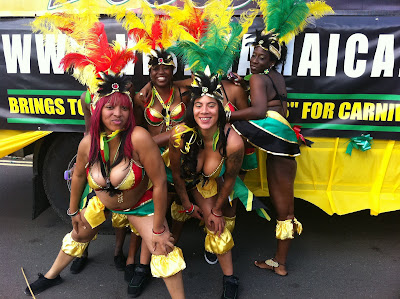
London’s Notting Hill Carnival has its roots firmly in the culture of the West Indian island of Trinidad, but since 2003, Jamaican Twist – the only Jamaican float to take part – has been an integral part, winning no less than six awards in the last three years.

There was some talk this year that the carnival would not go ahead in the light of the recent London riots. Boris Johnston said to cancel would have been to admit defeat, but the result would have been a lot worse than that. For many of the young, black and mixed race participants, it is a unique chance for them to express themselves and their culture.

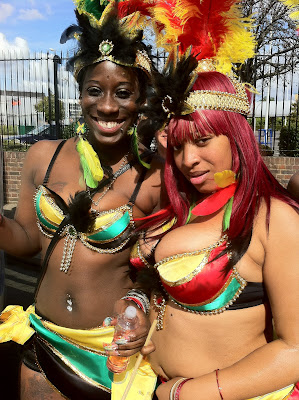
Feisty, busty, tattooed Natalie (21 years) has been many times carnival queen for Jamaica Twist which she has been part of since she was just 13. I ask her if it just Jamaicans who can join the float. ‘Nah, nah, we are Brazilian, Jamaican, Scottish… we come from all over. And Jamaicans come from all over. It is like we say, ‘‘Out of many, one people’.

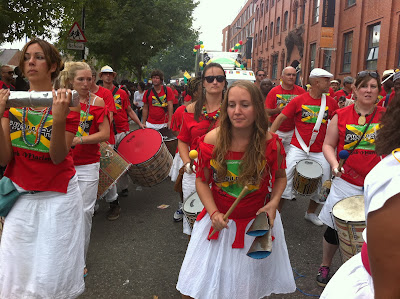
This is the fitting national motto and one taken up by the Jamaican Tourist Board, who sponsor the float each year. In true carnival spirit, Jamaican Twist collaborates with other musicians representing other islands and countries, including Trinidad and Tobago, Brazil and the South Pacific islands. Each year is a new theme representing a key part of Jamaican culture. This year it was it Bob Marley to mark the 30th anniversary of his death.

I couldn't imagine a better and stronger expression of community. And it is a particularly powerful statement when you remember that the first Notting Hill carnival was born out of a deeply racist and divided neighbourhood where signs saying: ‘No Blacks, No Irish, No dogs’ were commonplace.

Veronica, a charity worker, who volunteers with Jamaican Twist, explains that there are a lot of second and third generation Jamaicans who have never even been to Jamaica. The organisation, which also puts on events throughout the year, works very hard at engaging youngsters with a sense of pride of their community and of where they come from. ‘We have a very good Facebook page and we try to keep them interested in their culture, their music, dance and give them a bit of history. I do hope they dance decently today’, she says nervously.

They don’t. For a white middle class English girl like me, the grinding is shockingly sexual and I was surprised to see youngsters drinking brandy neat from the bottle at 11am. One young woman who had been to Jamaica on holiday skilfully grinded with the security guards, but at the same time three youths danced sweetly to a highly choreographed routine.

Carnival, despite what you might think, is not actually a spectator sport so I did my lame best to join in. Participants were not only of a mix of cultural heritage, but of all ages, backgrounds and dancing ability. We were issued with t-shirts (which most of the girls customised to make more revealing) and much needed ear plugs. The sounds from the three metre high walls of speakers that lined the Jamaican Twist truck were deafening. A tiny space in the middle was given over to a fridge, microwave and DJ. After a truly Jamaican start, we set off two and a half hours late, fortified with the best jerk chicken with rice and peas I have ever tasted and the strongest rum and coke.

Notting Hill may now be one of London’s most desirable areas, but as recently as the 1970s it was described as ‘a massive slum, full of multi-occupied houses, crawling with rats and rubbish’. Home to large communities of Afro-Caribbean immigrants, and racial tension inevitably reared its head. It was in this part of West London that the first race riots occurred in 1958. The Carnival was the joyous and peaceful response, which first took place indoors, but by 1965 had taken to the streets. The multi cultural celebration has grown each year and now sees around two million visitors over the two-day event.

Alexander D Great, the UK Calypso Monarch explained: ‘That procession declared to the British public how Caribbeans celebrated - with joy and with laughter and with jumping and dancing - an event like this, and the carnival is also representative of the same thing. And maybe this was the first time that the British public saw the Caribbean spirit in Britain in the open air.’

For just |15 pounds (for a t-shirt and to follow the float) anyone can join the carnival. If you want to wear a costume, it is 85 pounds, which also includes a meal, drinks and patties.

www.jamaicantwist.com/membership.

Notting Hill Carnival in London is second only to Rio’s in Brazil. And my advice to enjoy both is the same: join in.